Most people looking for free AI tools have already been burned once. You find a list, pick something that sounds useful, sign up, and then discover it was a seven-day trial, or that the one feature you needed sits behind a paid tier, or that your allowance ran out four prompts into real work.
The problem is not that free AI tools do not exist. Plenty do, and some of them are genuinely good. The problem is that the word "free" gets applied to at least five different arrangements, and most lists do not tell you which one you are looking at.
This guide sorts that out first, then names specific tools in each category with their actual ceilings. Everything here was checked against current official product information in September 2026. Free plans, models, and limits in this category change often, sometimes within weeks, so treat the specifics as a snapshot and confirm anything that matters on the vendor's own page before you commit time to it. Where a figure comes from independent observation rather than official documentation, that is stated.
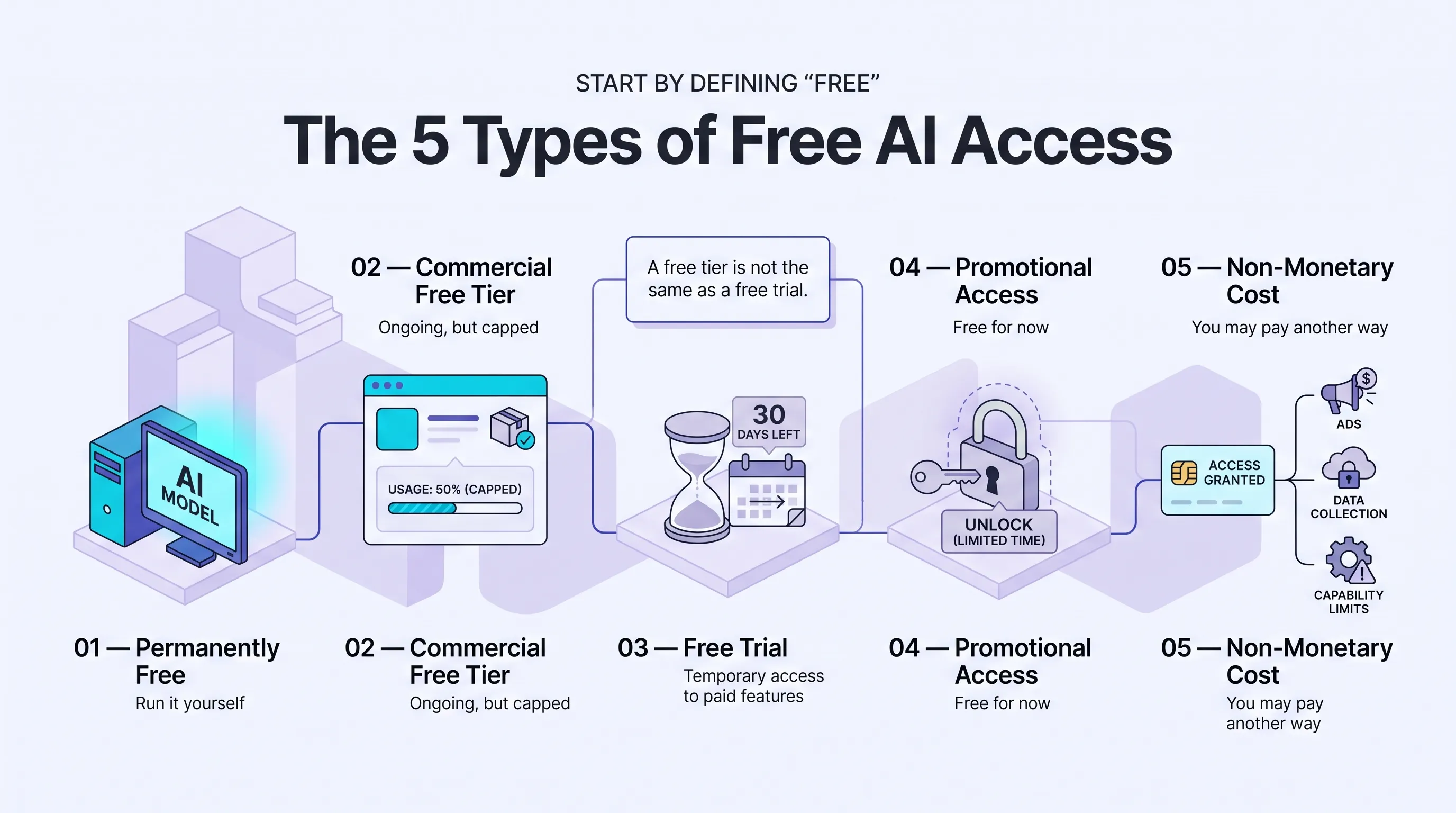
The Five Kinds Of "Free" In AI Tools
Before any list is useful, you need a way to classify what you are being offered. Nearly every free AI tool falls into one of these five categories, and knowing which one you are dealing with tells you more than any feature comparison.
CategoryWhat it meansExampleWhat to watch | Permanently free software | Open-source or free-to-use software you run yourself | Ollama, Jan, GPT4All | Hardware, setup effort, output quality | Current commercial free tier | An ongoing no-cost plan inside a paid product | ChatGPT Free, Claude Free | Usage caps, gated features, terms can change | Free trial | Time-limited access to a paid plan | Most SaaS trials | Expiry date, card on file, auto-renewal | Promotional or temporary free access | Something previously paid, currently free | Perplexity's Comet browser | Access terms can be revised | Free with a non-monetary cost | No payment, but you pay another way | Free developer API tiers | Ads, data use, capability limits
The distinction that matters most is between the second and third rows. A free tier is a plan you can stay on indefinitely under its current terms. A free trial is a paid plan you have not started paying for yet. Lists that mix them together are the single biggest reason people end up frustrated, and a tool does not belong on a free-tools list simply because no payment is required on day one.
Permanently Free: Open-Source And Local AI Tools
This is the closest thing to genuinely free, and it is the category most roundups skip because none of these tools have a marketing budget.
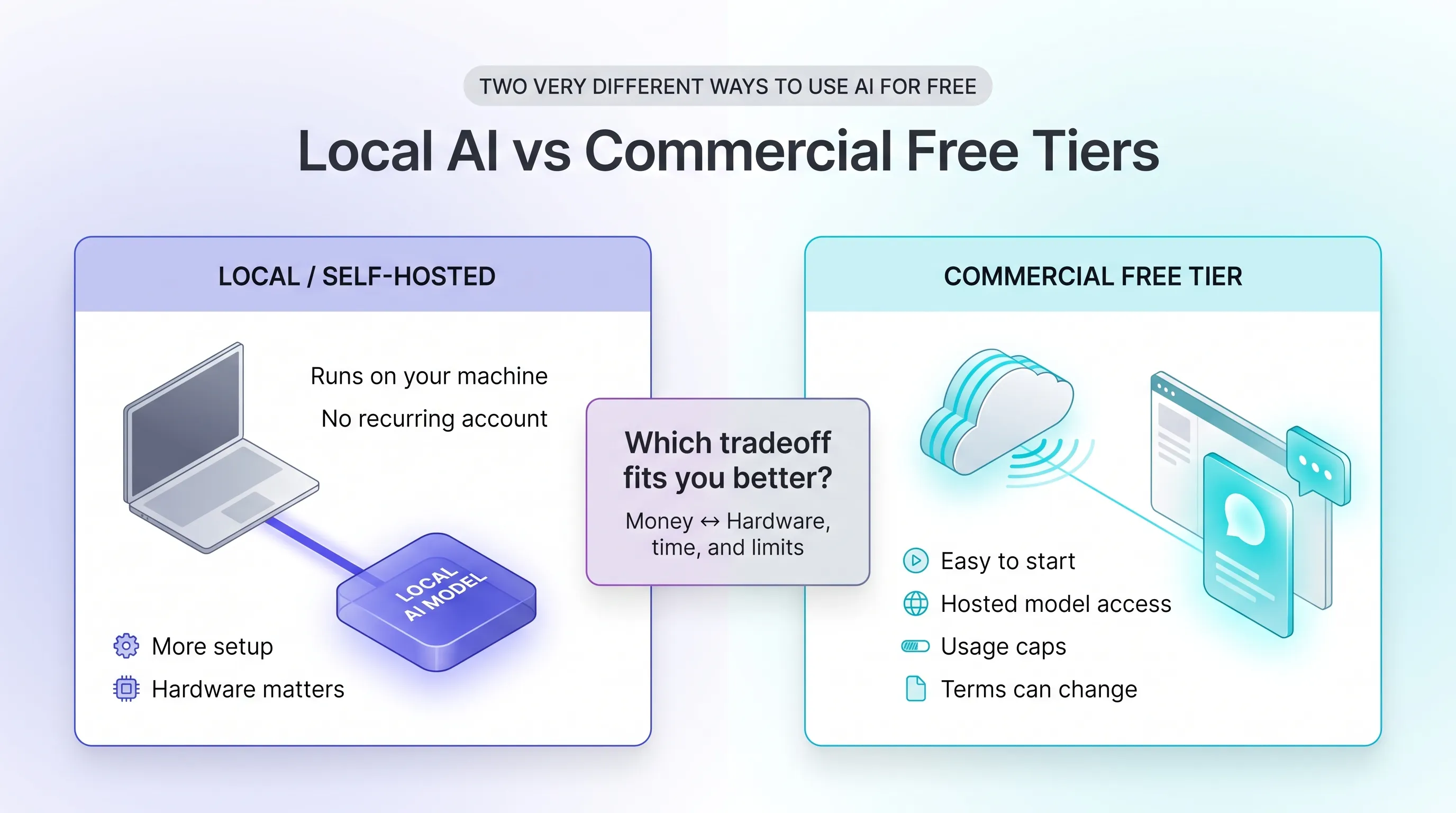
Open-weight models run on your own machine through a local runner. Ollama is the common starting point for developers, running as a background service with a command-line interface and an OpenAI-compatible API that other tools can plug into. LM Studio covers the same ground with a desktop interface and a built-in model browser, and is free for personal and commercial use, though its core application is proprietary rather than open source, with only its SDKs and CLI released under an open license. Jan is fully open source under Apache 2.0 and aimed at people who want an offline chat app they can inspect. GPT4All from Nomic AI focuses on private on-device use, including analysis of local documents. llama.cpp is the inference engine underneath much of this category, for people who want direct control.
Who these realistically suit: developers, privacy-sensitive users, anyone working with material they would rather not send to a third party, and people who want AI access without a recurring account relationship. No account and no card are required for any of them.
The honest limitation is twofold. These tools are free of charge, but not free of cost. You need a reasonably capable machine, and you pay in electricity, disk space, and setup time. More importantly, the open-weight models you can run at home are generally a step behind the frontier models the commercial products serve. For summarizing, drafting, coding help, and question answering, that gap is often acceptable. For your hardest reasoning tasks, you will notice it.
Current Free Tiers From The Major AI Assistants
These are the workhorses for most people, and they have become substantially more capable. Every limit below reflects official documentation as of September 2026.
ChatGPT Free. OpenAI's documentation states that Free users have unlimited everyday text chats, subject to abuse-prevention safeguards, and that file uploads, image generation, voice, data analysis, and other tools carry separate usage limits. That distinction is the one to internalize, because "unlimited" applies to ordinary text conversation, not to every feature in the product. On the model side, OpenAI states that Free and Go plans do not include GPT-5.6 Sol and instead receive GPT-5.6 Luna, with rollout happening gradually. An account is required; no payment method is. Best suited to people whose main need is writing, drafting, explaining, and everyday questions rather than heavy file or image work.
Claude Free. Anthropic's pricing documentation states that every plan meters usage against a rolling five-hour session window, that there is no fixed message count because consumption depends on conversation length, model, and features used, and that the Free plan covers everyday questions while Pro provides at least five times more usage per session. Claude Sonnet 5 is available on the Free plan. Independent testing through mid-2026 has estimated free usage in the range of roughly 15 to 40 messages per five-hour window, but that figure is an observation rather than a published limit, and Anthropic's own framing is deliberately qualitative. Note also that Claude Code is not included on the free plan. An account is required; no payment method is. Best suited to focused work sessions rather than all-day use.
Gemini. Google runs two separate free offerings that are frequently confused, and keeping them apart will save you time. The consumer Gemini app has its own free tier with its own model access and compute-based limits, sold alongside paid Google AI plans. Separately, Google AI Studio provides a free tier of the Gemini API for developers, where a Free Tier project can use certain models up to their applicable free-tier limits with no billing account required. Which models qualify and what the per-project request and token limits are can change, and Google surfaces the live limits for your project inside AI Studio rather than in a static page, so check there rather than trusting any article's table. These serve different people: the app for general assistance, the API tier for prototyping and small integrations.
Perplexity. The free tier provides cited, search-grounded answers with a capped number of the heavier research queries per day and limited file uploads. Perplexity's Comet browser is free to download and use, which is a real and unusual offer. The more autonomous browser-agent capability, however, is gated by plan rather than included at the free level. Best suited to anyone whose questions are mostly about current facts and who wants sources attached.
Two things are worth noticing across all four. First, an account is required everywhere, so "free" here means no payment rather than no signup. Second, the free tiers differ less in model quality than they used to and more in where the ceiling sits and how quickly you reach it.
Free Trials And Promotional Access Are Different Things
A free trial is not a free tool. It is a paid plan with the billing deferred, and it belongs in your evaluation process rather than in your permanent stack. OpenAI, for example, documents a separate promotional program in which eligible users can invite others to a free limited-duration trial of an otherwise paid subscription, with the duration and conditions set per campaign. That is a useful thing to accept, and it is not the same as a free plan.
The practical rule before signing up for anything: check whether a payment method is required, whether the offer has an end date, and what happens on that date. If a card is required, set your own reminder rather than trusting theirs.
Promotional or temporarily free access is a third situation, and Perplexity's Comet browser is the clearest example. It launched gated behind a $200 per month plan and a waitlist, and Perplexity removed that paywall in October 2025, releasing it broadly at no cost. It is genuinely free to use today. It is also a reminder that access terms are set by the vendor and can be revised in either direction, which is a reason to avoid building anything critical on top of an arrangement that changed once already.
Free AI Tools For Specific Tasks
A few practical notes, kept deliberately brief because each of these areas deserves its own treatment.
For images and video, free generators are widely available, usually with daily output caps, queue priority tied to paid plans, and licensing terms that vary on whether you may use the output commercially. Check the license before using anything client-facing.
For transcription and meeting notes, most tools in this category run a free tier metered in minutes per month rather than in features, so estimate your monthly call volume before choosing.
For coding, free access is uneven and moves quickly. Some assistants include free tiers, some restrict free access to their lighter models, and at least one major vendor retired its individual free tier during 2026. Local runners paired with open-weight coding models remain the most stable free option here.
For developers generally, free API tiers from the major providers are the most practical zero-cost route to building something, with the caveat covered in the next section.
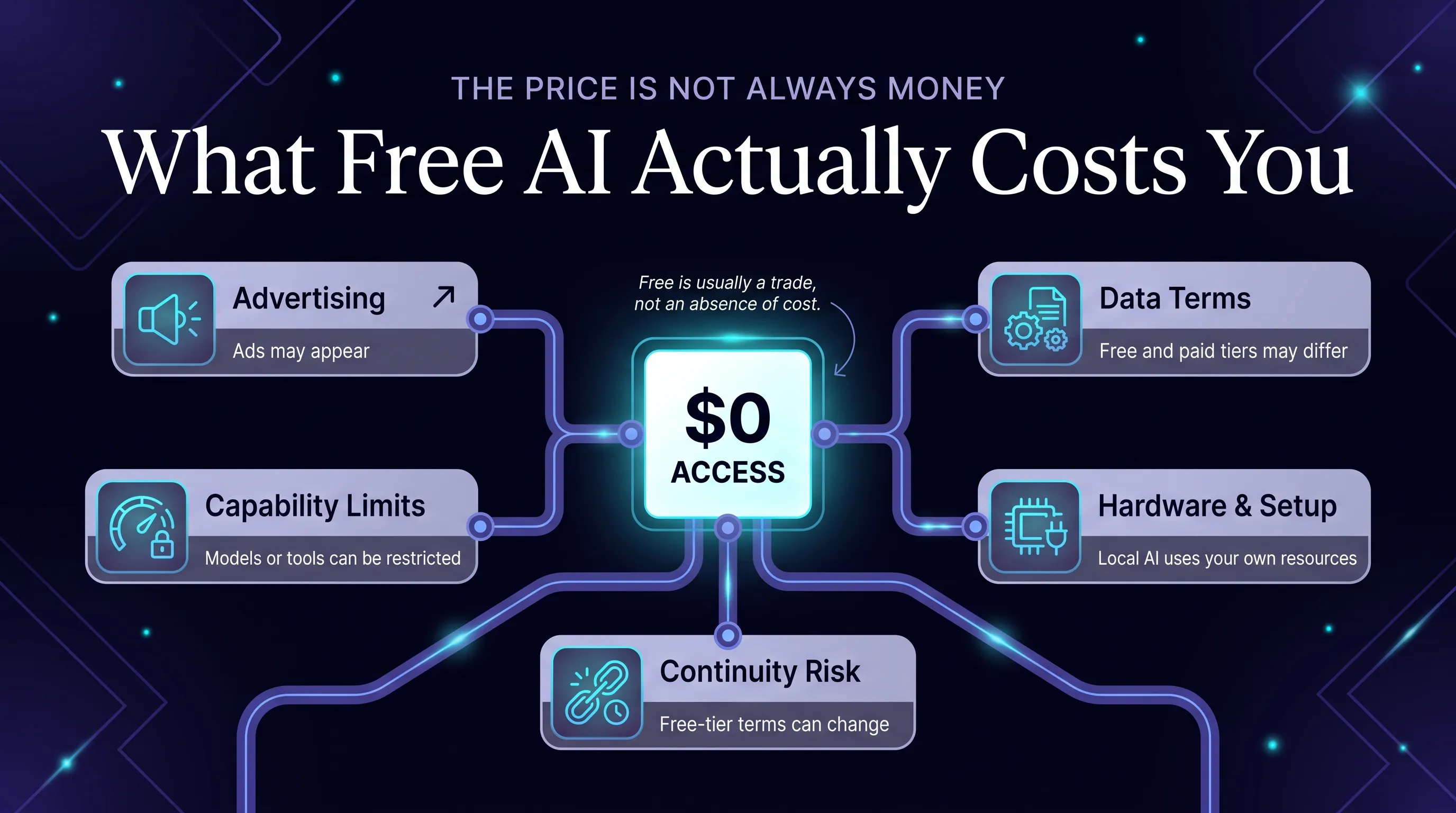
What Free Actually Costs You
Free is rarely free. It is usually a trade, and the terms differ by vendor, so these are specific rather than general claims.
Advertising. OpenAI's Free tier FAQ states that ads may appear in the Free tier in certain countries and directs users to a separate ads FAQ for current availability and controls. It also notes that ad testing may extend to the Go plan in future. This is regional and evolving, so whether you see ads depends on where you are.
Data handling on free developer tiers. Free API access frequently carries different data terms than paid access. Reporting on Google AI Studio's free tier indicates that free-tier inputs and outputs may be used to improve Google's models, which is a meaningful consideration if you are prototyping with anything sensitive. This is exactly the kind of term that differs between a free tier and a paid or enterprise arrangement, and it is worth reading rather than assuming. Check the specific vendor's current terms for the specific plan you are on, because the answer is not the same across products and it is not the same across tiers of the same product.
Capability limits. The most common cost is the one you notice mid-task. Free plans across these products restrict the stronger models, the heavier features, or the throughput. The distinction OpenAI documents between unlimited text chat and separately limited tools is a good illustration: the limit has not disappeared, it has moved to the features you reach for occasionally.
Setup and hardware. For local tools, the trade is your own equipment and time. A machine that cannot comfortably run a mid-sized model will give you a slow, frustrating experience that no amount of software choice fixes.
Continuity risk. Anything you build inside a free tier is subject to that tier's terms continuing. Export what matters.
None of this makes free tools a bad choice. It makes them a choice with terms, which is all anyone needs in order to decide well.
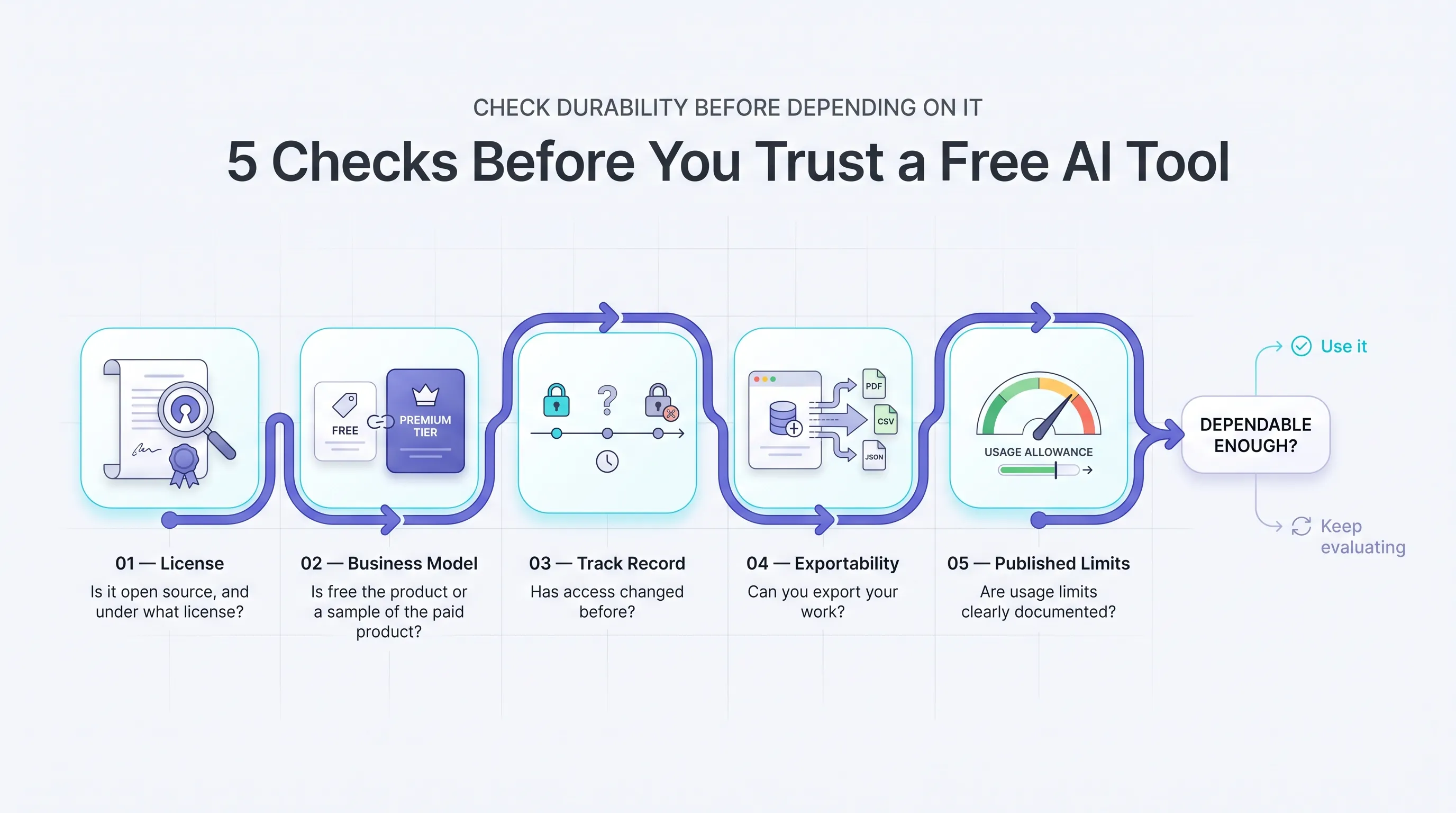
How To Check Whether A Free Tool Will Stay Free
Nobody can tell you what a vendor will do next year, and any article that claims to is guessing. What you can do is read the signals, and the useful ones are concrete.
Is it open source, and under what license? A permissively licensed tool you run on your own hardware cannot be taken away from you. This is the strongest form of durability available, and it is why the open-source category deserves consideration even if the models are a step behind.
Is the free thing the product, or a sample of the product? A free tier that exists to demonstrate a paid product is more likely to be adjusted than one that serves the vendor's own strategic purpose. Neither is a guarantee.
Has the vendor changed these terms before? Track record is the most useful signal available, and this category has plenty of it. During 2026 alone, free-tier model access shifted at multiple vendors, one major provider retired an individual free tier for its coding assistant in June, and another moved a previously paid product to free. Movement in both directions is normal here.
Can you export your work? If the answer is no, treat that as a cost regardless of the price.
Are the limits published or discovered? Vendors who document their limits clearly are easier to plan around than vendors whose limits you learn about by hitting them.
Run these five checks on anything you are about to depend on. They take a few minutes and they are more useful than any prediction.
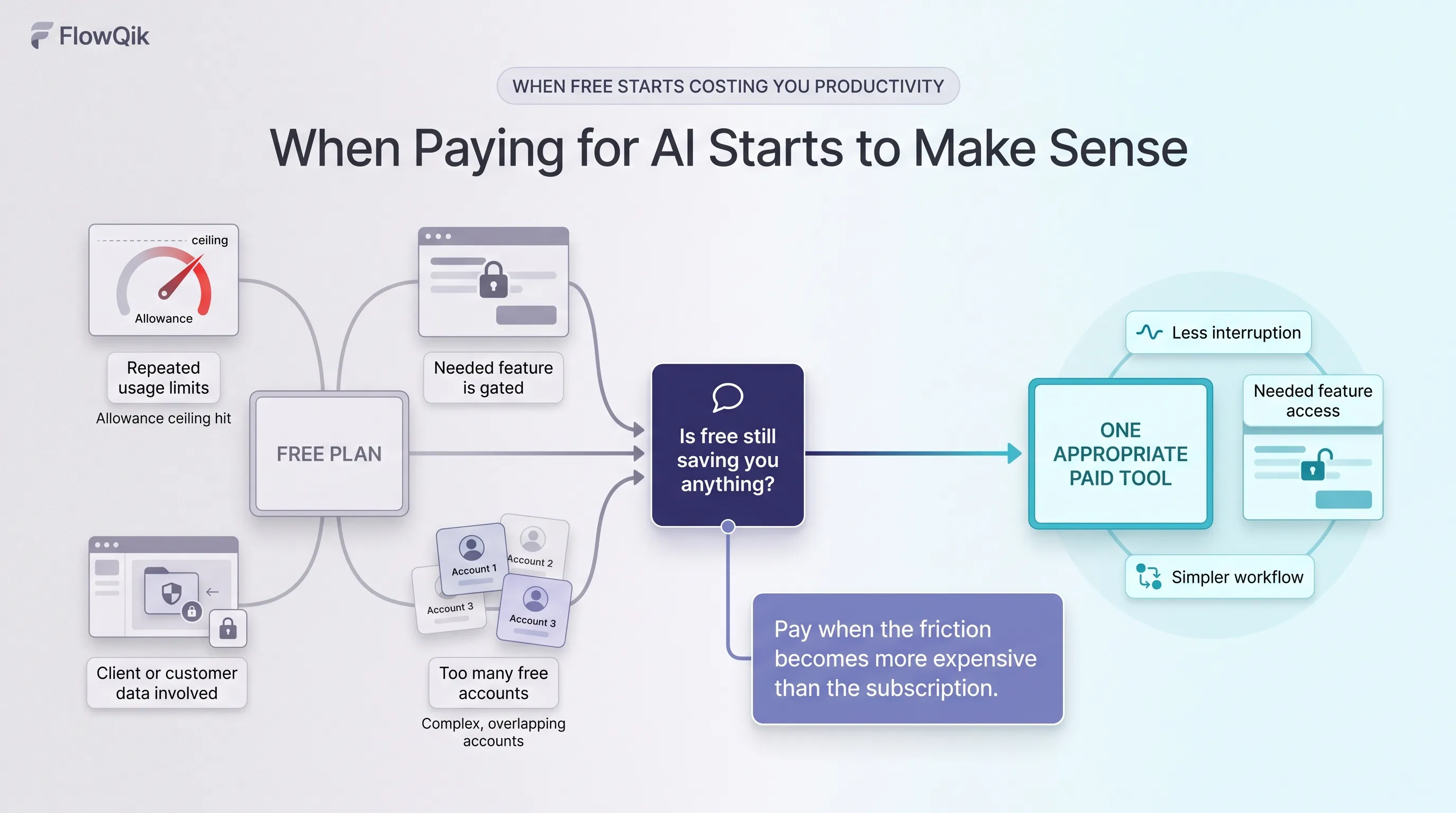
When Paying Starts To Make Sense
There is a point where free stops being economical, and it is worth naming honestly rather than pretending otherwise.
If you hit a usage ceiling several times a week, the free plan is costing you interrupted work rather than saving you money. If the specific feature you need is gated, no amount of switching between free tiers will produce it. If you are handling client or customer data, the data terms attached to paid or business plans are frequently different from the free ones, and that difference can matter more than the subscription price. And if you find yourself maintaining accounts across four free tools to dodge four separate caps, the coordination cost has quietly exceeded what one subscription would have been.
Until one of those applies, the free options described here are genuinely sufficient for a large amount of real work.
Frequently asked questions
Some are, some are not, and the label does not tell you which. Open-source software you run yourself is free of charge indefinitely, though it costs you hardware and setup. Commercial free tiers are free under their current terms but capped. Free trials are paid plans with deferred billing. And some free products carry non-monetary costs such as ads or different data-handling terms. Classify before you sign up.
A free tier is an ongoing plan with no end date under its current terms, usually with usage caps. A free trial is time-limited access to a paid plan, often requires a payment method, and typically converts automatically. Before signing up for anything, check for three things: an end date, a card requirement, and what happens when the period ends.
It depends on the vendor and on the specific plan, and free tiers sometimes carry different terms than paid ones. Free developer API tiers in particular can include provisions allowing your inputs and outputs to be used for product improvement. There is no universal answer here, so check the current terms for the exact product and tier you are using, especially before putting anything confidential into it.
Frequently yes, but verify rather than assume. Output rights and commercial-use permissions differ between free and paid tiers on some products, image and video generators vary considerably on this point, and open-weight models carry their own licenses with their own conditions. If the output is going to a client or into a product, read the license first.
Locally run tools are the reliable answer, since Ollama, Jan, GPT4All, and LM Studio require no account at all once installed. Perplexity's Comet browser can also be used for basic browsing and some AI features without an account. Most hosted assistants require at least an email address, though not a payment method.
Claude's free plan offers Sonnet 5 with session-based usage limits and suits focused work. Perplexity's free tier is stronger for questions that need current, cited sources. Gemini has a free consumer tier and, separately, a free developer API tier through Google AI Studio. For no account and no data leaving your machine, a local runner with an open-weight model is the alternative that behaves least like the others.
Open-source software you run yourself will remain available to you regardless of vendor decisions. Commercial free tiers exist under terms the vendor sets and can revise, and this category has seen changes in both directions during 2026. Rather than predicting, check the signals described above and keep exports of anything you would not want to lose.
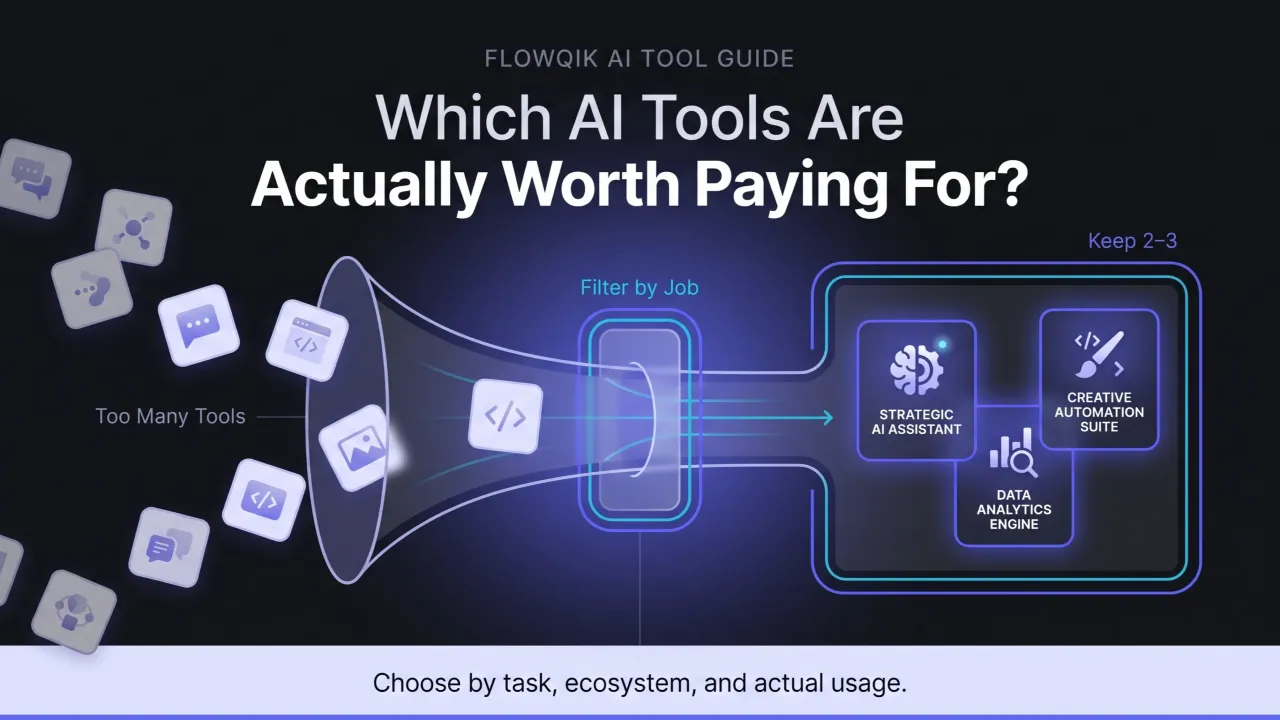
This guide takes a different approach. Instead of cataloging everything, it explains the four layers of AI tooling that most roundups blur together, gives you a small curated set of tools worth considering in each one, and tells you what each is genuinely good for and where it will frustrate you. The goal is that you finish with a shortlist of two or three tools, not a bookmark folder of thirty.
Discussion
Comments
No approved comments yet. Be the first to join the discussion.